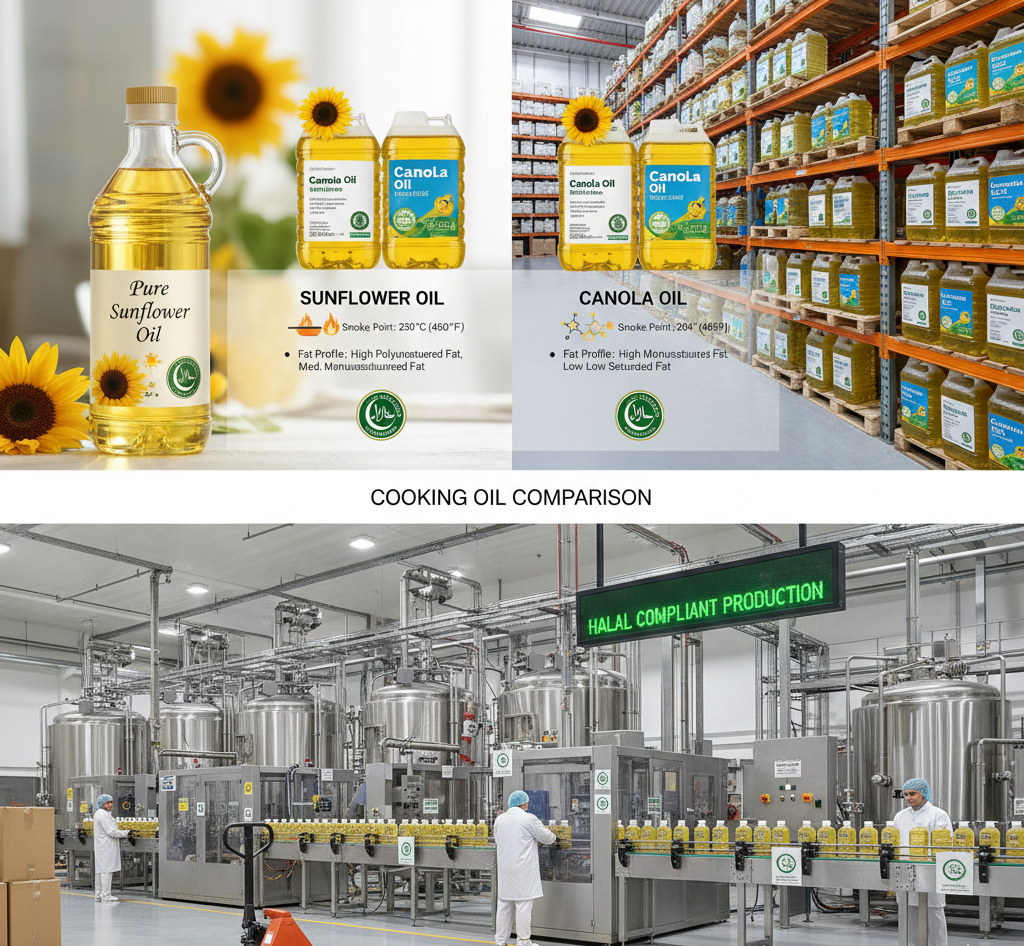

Best Halal Cooking Oil Supplier: Sunflower Oil, Canola Oil and More
When you’re on the hunt for a halal cooking oil supplier, especially for popular oils like sunflower oil and canola oil, you’re not just buying any bottle. You’re looking for assurance on quality, sourcing, certification and consistency. Whether you’re a restaurant, a catering business, or simply upgrading your kitchen pantry the stakes are real. Let’s walk through how to pick the right supplier and what to look out for.
Why Choosing a halal cooking oil supplier Matters
First and foremost: “halal” isn’t just a label it’s a trust signal. When an oil is certified halal, it means the entire process from seed to refining to packaging meets a standard aligned with Islamic dietary law. This includes raw materials, equipment, cross contamination, processing aids, etc. Without the right supplier, you risk buying oil that may not fully comply or be subject to adulteration.
Additionally, if you operate a business in a Muslim-majority region (like the UAE, Saudi Arabia, Malaysia), halal certification can be mandatory for regulatory compliance or for earning customer trust.
What Does “Halal” Mean in Cooking Oils
In the context of cooking oils: not all oils need slaughter-based ritual (those relate to animal-derived ingredients). But what matters here is that the raw materials (seeds, kernels), refining aids (chemicals, filters), equipment, packaging and storage are all free from non-halal impurities and cross-contamination. Also, many halal certifiers check for the absence of alcohol or pork-derived processing aids.
In short: if your supplier claims “halal cooking oil”, you’ll want to review their certification, batch traceability, and that the facility is vetted.
Key Certifications to Look For (Halal, HACCP, ISO, Non-GMO)
A quality supplier will often list:
- Halal certificate from a recognised body (e.g., JAKIM, ISA, RI&CA) e.g., a canola oil supplier showing Halal certificate.
- ISO 22000 / HACCP / FSSC 22000 for food-safety systems.
- Non-GMO or high-oleic seed sourcing (which also appeals to health-conscious buyers). For example, one sunflower oil supplier lists non-GMO plus halal.
- Traceability documentation: batch numbers, origin of seeds, refining details.
Having these certifications makes the difference between a good supplier and a truly reliable one.
Sunflower Oil: Popularity, Benefits & Halal Supply Considerations
Sunflower oil is one of the most widely used cooking oils globally thanks to its neutral flavor profile, high smoke point and mild taste. It’s ideal for frying, sautéing, baking and salads.
Nutritional Profile & Smoke Point of Sunflower Oil
This oil is typically rich in vitamin E, low in saturated fat, and offers a good smoke point (refined versions often handle ~230°C+). For instance, one supplier lists smoke point 232°C.
From a culinary standpoint, its light nature means it doesn’t overpower foods which is why many food-service kitchens favour it.
Sourcing & Supply Chain Issues for Sunflower Oil (Halal certified)
When sourcing halal sunflower oil, keep an eye on:
- Seed origin: Some regions may use older seed stocks or less rigorous refining practices.
- Refining aids & bleaching/deodourising: Are chemicals used acceptable under halal standards?
- Packaging and storage: Oil quality can degrade over time if stored improperly (leading to rancidity).
- Bulk vs retail: If you’re buying in bulk, ensure the supplier can provide halal certification for entire containers and that logistics (tankers, flexi-tanks) maintain halal integrity.
For example, a supplier advertises “Halal, Non-GMO, ISO 22000” for its refined sunflower oil.
Canola Oil: Why It’s a Top Choice and Halal Options
Canola oil (essentially a refined form of rapeseed oil bred for low erucic acid) has become a mainstream cooking oil, prized for its neutral taste, high smoke point, and favourable fatty-acid profile (low saturated fat, high monounsaturated fat).
Understanding Canola vs Rapeseed & Health Aspects
Though “rapeseed” can sound technical, the modern canola varieties are safe, regulated, and widely used in foodservice. Many health-conscious kitchens favour canola for its heart-friendly profile.
Also, for halal compliance: modern canola oils are refined just like sunflower oil, but you’ll want to ensure the supplier provides valid halal certification. For instance: one supplier lists “Canola Oil – certified Halal by Jakim (Malaysia)”.
Another example of halal certified canola oil: products labelled “Halal” in the listing.
Trusted Halal Canola Oil Suppliers & Certification Examples
- The company “AAK USA Richmond Corp.” holds a halal certificate for non-GMO canola oil.
- The raw-ingredients marketplace lists canola oil with Halal, Kosher, Non-GMO certifications.
- A UAE distributor mentions supply of canola oil with “Halal certification guarantee” for bulk shipments.
This demonstrates there are reputable suppliers you can work with, both retail and bulk.
How to Evaluate a Good Halal Cooking Oil Supplier
Whether you’re buying a few bottles for your home or sourcing tonnes for a hotel or food-service chain, these criteria matter.
Quality Assurance: Certificates, Batch Traceability, Lab Tests
Check:
- Valid halal certificate (with expiry date)
- Origin of seeds and location of refining facility
- Test reports: free fatty acid value, peroxide value, smoke point
- Batch numbers: can you trace from seed to bottle?
- Packaging integrity: was the oil stored and shipped in food-grade containers?
Packaging, Storage, Bulk Shipping & Regional Logistics
If you're sourcing in Dubai or the UAE (or exporting from there), think about:
- Storage conditions (cool, dry)
- Packaging sizes (1 L, 5 L, 25 L jerry-cans, IBCs)
- Shipping: ISO tanks or flexi-tanks for bulk vs drums/containers
- Regulatory compliance: customs, halal certification for import/export
- Lead time and volume flexibility: ability to adapt to demand changes
For example, one supplier outlines packaging options from 1 L bottles up to flexitanks (~20,000 litres).